9 de junio de 2006

Soberbia y pasión VI


Gustavo Tabares + Mercedes Bustelo + obra

plano

Obra de Rulfo

Lacasa + Tabares + Tavella con obra de Rulfo

Obra de Burgos


Jacqueline Lacasa + Mariana Duarte + Gustavo Tabares

Jacqueline Lacasa + Enrique Aguerre + Gustavo Tabares

Obra sin montar de Alejandro Turell + Enrique Aguerre + Sergio Meirana

Obra embolsada de Aguerre


Obra de Ernesto Vila

Soberbia y Pasión V


plano

Jacqueline Lacasa + Oscar Bonilla

Alicia Ubilla


Obra de Cristina Casabó

Soberbia y Pasión IV


Un clásico...

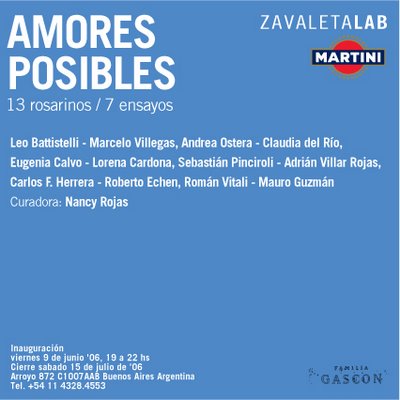
Amores Posibles

Soberbia y Pasión III


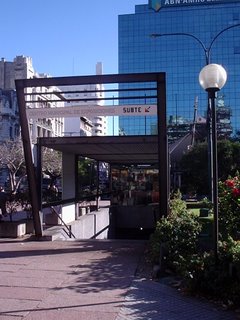
Jacqueline me había ofrecido por teléfono la posibilidad de un "cubo rojo" como soporte de mis tres imágenes y me fuí hasta el Subte a verlo, una vez en el lugar me pareció buena idea. Para mí es un "prisma rojo" ó un "cuboide prismático". No sé.

Soberbia y Pasión II


Ayer comenzamos el montaje de las diferentes obras y éste era el estado pre-exposición de la sala que se me presentó como una verdadera instalación de Imi Knoebel.

7 de junio de 2006

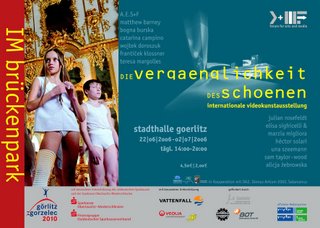
De Héctor Solari


http://www.goerlitz2010.de/

Badaró desde Alaska


Entrevista completa de Dawnell Smith del Anchorage Daily News a nuestro colega Enrique Badaró Nadal. Imperdible la intro..."Enrique Badaro Nadal lives in a city known for architecture, sunshine and gorgeous beaches." Guau!

Uruguayan artist muses on his winter in Alaska as Fulbright scholar

By DAWNELL SMITH
Anchorage Daily News

Published: June 4, 2006
Last Modified: June 4, 2006 at 04:20 AM


Enrique Badaro Nadal lives in a city known for architecture, sunshine and gorgeous beaches. When at home in Montevideo, Uruguay, he runs the Subte Museum and directs visual art programs for the city. He also paints, draws, builds stages, makes prints and fashions installation art that incorporates text with imagery loaded with cultural motifs and wry sensuality.


Badaro Nadal has studied in Bolivia, Peru, Chile, Argentina, Cuba and France. But as a Fulbright scholar, he found himself immersed in a stark and barren winter in the Mat-Su this January, teaching art at the Matanuska-Susitna campus of the University of Alaska Anchorage and embracing darkness, whiteness, nothingness and brightness.

Gracious in demeanor and eager to absorb the environment, Badaro Nadal has spent the last five months teaching classes, creating art, building sets for high school theater productions and staying involved in the Mat-Su community.

Last month, he juried a show for the International Gallery of Contemporary Art, where he showed some of his own Alaska-made work, and this month his installation piece, "Blood," appears at the UAA Student Union Gallery in a group show called "Seeing Red," an exhibit by Mat-Su college faculty.

Badaro Nadal will turn 50 in August, his last month in Alaska, but will stay busy to the end, even when his wife and daughter visit next month after six months apart. His 18-year-old son has kept him company since February, and the Internet has allowed him to make daily contact with friends and family all over the world.

In these last few months of his stay, Badaro Nadal will teach summer classes in collage, contemporary painting and other topics, and maybe travel around a bit more. UAA gave him the use of a car along with a teaching salary, and the Fulbright program supported his trip through grant money and air tickets.

Badaro Nadal spoke enthusiastically about his time in Alaska during an interview last week. The following excerpts have been edited for length and clarity.

Q. You arrived in the thick of January and have yet to feel the full brunt of summer, but what are your impressions of Alaska so far?

A. From the first moment here it was very exciting because of the nature of winter and now summer. Just being here for the coming of the sun after having been here in the winter is exciting, just seeing this big bag of nature appear in one week. It's all green and full now.

Our seasons in Uruguay are slower in changing. Here it is very sudden.

Q. As a Fulbright scholar, did you get to choose where you wanted to go?

A. The Fulbright office offered the possibility of applying to Alaska. It was not easy for Mat-Su to find someone to come up here. It took two years. They were looking in Chile, Bolivia, Argentina, and later they opened it up to Uruguay.

In my case, it's a senior program. I came as an artist for teaching experience. My grant was for teaching at Mat-Su College, and that's where I have spent all the winter and spring. I taught four courses in color design, stagecraft, contemporary painting and perspective.

I worked very well with the students and faculty members, the coordinator of the department. They all helped me all the time, so I felt at ease from the beginning.

Q. Were there challenges adjusting to the expectations of your job or the environment?

A. When I arrived, there were just three hours of twilight. It was dark, but when the sun was out you saw all the white landscape. I was impressed by nature, the sky, the snow, the ravens, the mountains.

I had a nice house in the Valley and I felt comfortable at work. The people at Mat-Su helped me feel comfortable. When you are so far away from home, you have to have what you need to feel comfortable and be able to work.

Q. How has being here influenced your art?

A. You know, the landscape is so important. One concept I included from Alaska is emptiness. Here the sky is changing. You see the white plains in the winter. You see nothing.

This doesn't mean I make a description of this in my art. It's more of the concept of big space, nature and not being afraid of emptiness that comes through. It's a very Eastern concept.

Yes, if you come to Alaska and you work in a sensitive field like the arts, it's impossible to not be influenced by the environment, the Native art, the cultures, everything that passes through here. Like the ravens you see all the time ... you learn how important Raven is to Native culture. You begin to see links in what you see in the land and what happened in the past.

Everything is connected. The presence of animals -- the moose, the eagles, the bears -- makes you feel very close, very connected to nature.

Q. Explain how these concepts showed up in your recent show at the International.

A. I made those pieces in Alaska. I had an idea before I came up here that Alaska is a bridge between Eastern places and America. Alaska is the bridge of our cultures. Many, many cultures came over this bridge between the Asia continent and the American continent.

In my show here, I used a lot of elements from Eastern culture like Japan and a lot of elements from American pre-Hispanic cultures.

In the big canvas I had two big figures, one right side up and the other upside down, to represent those people who came from the north to the south; and then me, who came from the south to the north. It's kind of a cycle, a movement that never stops.

That is another idea that has shown up: there are no borders; we are moving all the time; we are interconnected. Nobody can stop that. It's natural. It's part of being human.

Q. Tell me about your hometown.

A. Montevideo is a beautiful city with one and a half million people. It has beautiful architecture with many French elements. It has lots of French influences. It lies on the coast, which means we have beautiful beaches. We grow up going to the beach and walking along the coast.

It's a very green city with lots of parks and squares.

Q. It sounds quite different from Alaska in terms of architecture and city planning then.

A. Architecture in Uruguay is a very important field. In the last 20 years, we have started to have a conscience about keeping the architecture and not tearing it down, about taking care of it.

We have a huge period of art deco architecture with stained glass and facades.

Q. Do you think that this is something missing in Alaska, that there is a lack of appreciation and admiration for architecture?

A. That's a hard question. Everything looks so new, so recent here. The concept of wood is big and there are not so many high buildings. At the same time, it's interesting how fast Alaska grows and builds and makes new neighborhoods. It's fascinating the speed which you have for growth. It's impressive.

You know, I have lived in Paris for some years. When you live there, you're impressed with the churches, the palaces, the museums, the towers. When you come to Alaska it's the opposite. You fall in love with the beauty of nature and the people here. You don't care as much for the buildings. Architecture here is seen only as useful.

And you need to grow up (as a state); Alaska is a growing-up state.

Q. You're still working on your piece for the upcoming show, "Seeing Red," which goes up tomorrow, and you had really fresh work at last month's International exhibit too. Do you find it nerve-wracking to exhibit work that is so new?

A. I always show really new work and I always work toward shows. It comes out so fresh you have to blow on it. Sometimes I will show something old for a group show or something, but mostly I only do new work.

When you are over 40 years old, you cannot be afraid or nervous. You have to do things. In this case, I am here for only so long. This is it. When they offer an opportunity to exhibit my work, it's wonderful and I do it.


--------------------------------------------------------------------------------

Daily News arts reporter Dawnell Smith can be reached at 257-4587 or dsmith@adn.com.


--------------------------------------------------------------------------------


ENRIQUE BADARO NADAL will present a lecture, "Earth Art: Pre-European and Contemporary Arts in Alaska and Latin America," at 2 p.m. June 25 at the Anchorage Museum of History and Art. The presentation will makes connections between contemporary artists like Andy Goldsworthy and the pre-Columbian period. His work is featured in "Seeing Red," a show by Mat-Su College faculty, at UAA's Student Union Gallery until June 14. See the review below.

6 de junio de 2006

Carsten Höller - Upside Down Mushroom Room


En el próximo mes de octubre en la Tate Modern...

Soberbia y Pasión I


Hoy era la fecha acordada para entregar la obra que formará parte de la exposición colectiva "Soberbia y Pasión" curada por Jacqueline Lacasa a realizarse en el Subte Municipal a partir del día 15 de junio a las 19 horas.
En mi caso es un hecho singular ya que es la primera vez que entrego un objeto desde el año 1983 (en realidad son tres) que no sea un rollo de película, un videocassette,un cd o un dvd. Se trata de tres imágenes fotográficas de 23 x 17cm pegadas en un soporte rígido gracias a la mano experta de Eduardo Acosta Bentos (tenemos que cambiar el último jpg de la página web!) que conforman la obra titulada "Paikx3".
Luego de un intercambio de info vía mail, un par de reuniones personales para charlar sobre la obra (producida especialmente para esta muestra) con la curadora y otra reunión colectiva donde compartimos un ping pong "cuasi" sesudo con los demás participantes sobre los diferentes significados de las palabras/términos "soberbia" y "pasión" con coca-cola de por medio terminé por elegir estas tres imágenes que en su origen forman parte de una familia más numerosa (15 imágenes) que tomé a partir de la instalación El Pensador - TV Rodin de Nam June Paik en la exposición "Smile Machines" de la Transmediale con la idea de hacer algo a mi vuelta a Montevideo para esta muestra.
Primer texto de la muestra para ir haciendo boca enviado por Jacqueline en el ya lejano mes de enero:

La propuesta consiste en trabajar sobre dos conceptos Soberbia y Pasión.

La Soberbia pone de manifiesto el lugar que se ocupa frente a un Otro. Muestra la labilidad entre lo majestuoso, la omnipresencia y lo inferior o pequeño. En cuanto a la profundidad del concepto podemos vincularlo a una forma peculiar de relacionarse con los objetos de deseo, con el tipo de elección que generamos y con la capacidad de establecer un espacio con respecto a un alter ego. La soberbia es un ejercicio que vamos incorporando desde temprana edad con nuestras experiencia y relación con el mundo adulto. Accedemos al conocimiento de sí mismo y de los otros
mediante modelos que ocupan un lugar de poder y de saber. La acción de ejercer la soberbia exige una posición, una localización y sobre todo extralimita la capacidad de exigir a un Otro o al grupo (tal es el caso de los líderes) las condiciones necesarias para seguir sustentando un quantum de represión sobre lo que se desea, tanto para someter como para ser sometido. En definitiva es un mecanismo defensivo que se vincula claramente con el control omnipotente de los objetos (sean personas o cosas). Estas acciones pueden ser ejercidas de forma inconsciente o con una estrategia predeterminada y dentro de una estructura funcional. Esto puede suceder en cualquier campo de producción intelectual, en una sistema de relaciones cotidianas como en una oficina una fabrica, en un sistema religioso o ideológico o en el sistema de producción artístico. Un ejemplo La Superbía (del latín lo que está por encima) es representada en una de las obras realizadas por El Bosco en su serie de Los siete pecados capitales. En esta obra seguro recordarán como la dama burguesa devota
y religiosa da vuelta la espalda al espectador y aparece su imagen La concepción de estas dos ideas surge a partir del análisis del discurso que define los rasgos característicos de las acciones socialmente aceptadas. Si lo que en el discurso se destaca es la mesura, el no exceso, lo que generalmente se ha denominado contra cultura o más recientemente se ha legitimado como arte emergente como forma de alcanzar la desmesura y de cuestionar lo establecido en un espejo ofrecido por el diablo en medio de un cúmulo de objetos que denotan su riqueza.

Por su parte la Pasión ejerce su fuerza, lo hace también en medio de relaciones de todo tipo y revela la intensidad que tenemos hacia nuestros objetos de deseo, (entendiendo objeto de deseo como las figuras amorosas padre, madre o amor carnal u objeto ideal). El origen de éste término se relaciona con el padecimiento o sufrimiento que tuvo Cristo en la cruz, o los mártires en general.
Luego su acepción evolucionó en el sentido del amor sexual en exceso, padecido por un individuo pasivo ante la fuerza ilimitada de la libido (energía sexual), a veces incluso percibida como un desorden en la conducta (tal es el caso del enamoramiento como lo planteaba Sigmund Freud).

También devela las diversas formas en las que se relaciona e individuo o colectivo con su líder o conductor (por el tipo de ligazón libidinal).

Ambos conceptos sugieren infinidad de situaciones reales o virtuales en el desarrollo de los diferentes discursos relacionados con el Poder. Estos términos tienen una carga por lo general negativa pero sin embargo su polaridad está presente en muchas de las acciones cotidianas.
La función es la develar el sentido latente de la soberbia y la pasión.
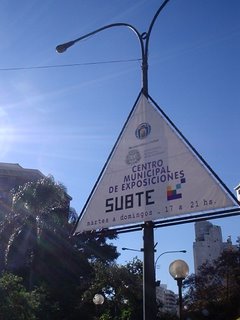
Artistas participantes: Mariana Duarte, Alicia Ubilla, Cecilia Matos, Cristina Casabó, Enrique Aguerre, Ernesto Vila, Cecilia Romero,Gustavo Tabares / Mercedes Bustelo, Juliana Rosales, Federico Aguirre, Mario D’Angelo, Oscar Bonilla, Nelbia Romero, Paula Delgado / Julia Castagno, Rulfo, Vladimir Muvich, Alejandro Turell, Martín Verges, Sergio Meirana, Angela López, Juan Burgos, Alejandro Albertti, Patricia Bentancur y Sergio Porro.